Will AI Replace Human Jobs? A Detailed Explanation
September 2, 2026
Artificial Intelligence is rapidly changing the way people work. AI tools can write content, analyze data, answer customer questions, create images, translate languages, and automate repetitive tasks. Because of these developments, many people wonder: Will AI eventually replace human jobs?
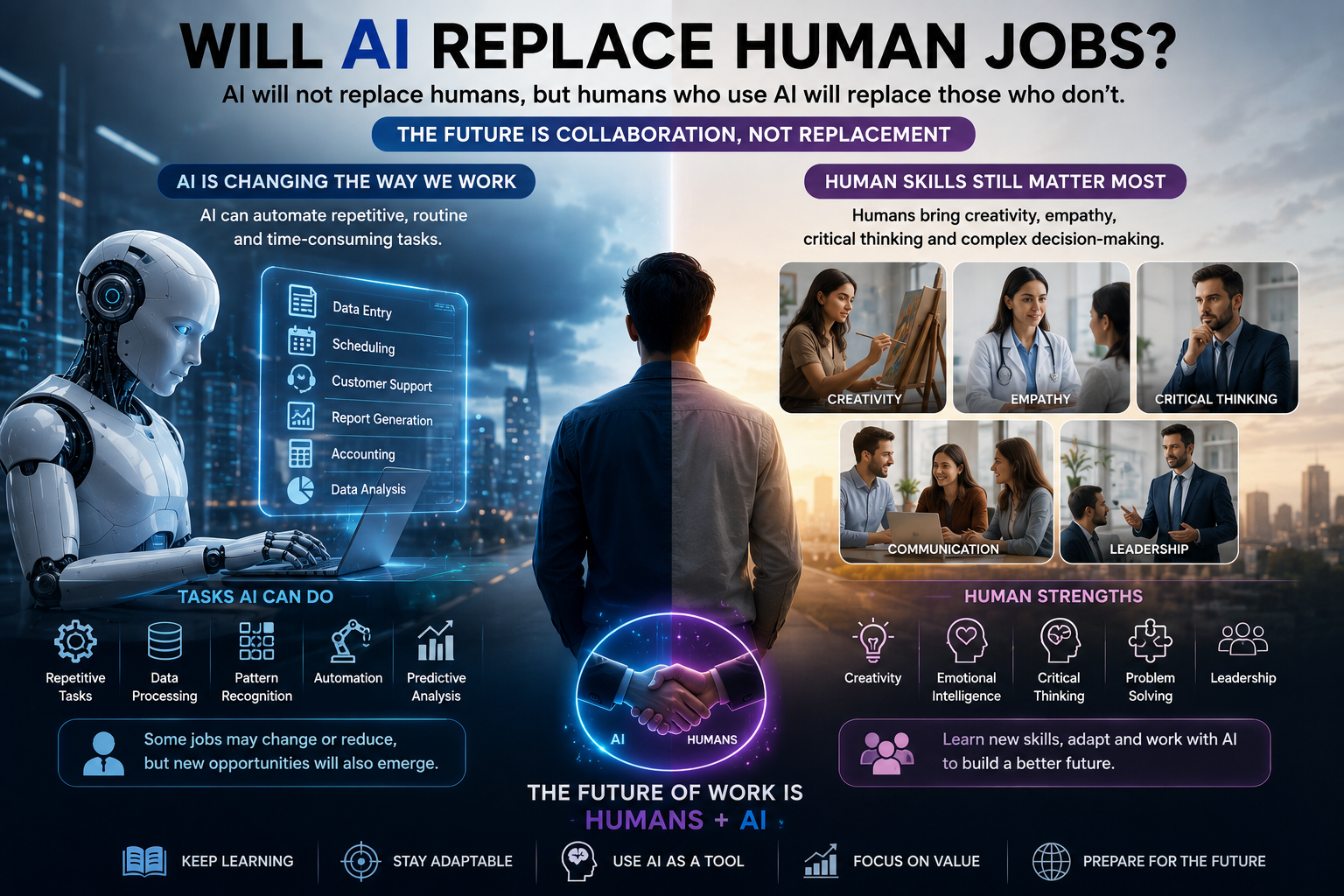
The simple answer is: AI will replace some tasks and change many jobs, but it is unlikely to replace humans completely.
1. AI Can Automate Repetitive Tasks
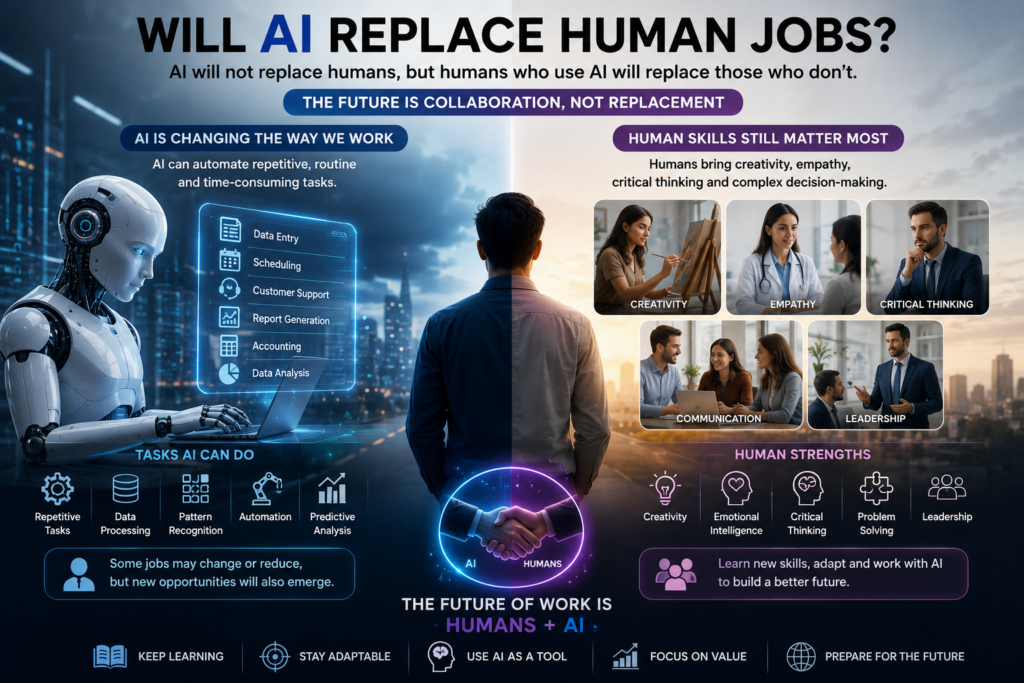
AI is particularly effective at performing repetitive and predictable tasks quickly. For example, AI can:
- Enter and organize data
- Answer common customer questions
- Analyze large amounts of information
- Schedule appointments
- Generate basic reports
- Translate simple content
- Monitor systems
Jobs that mainly involve repetitive tasks may experience significant changes because companies can use AI to complete some work faster.
2. Some Jobs May Be Reduced or Changed
Certain roles may require fewer workers as automation becomes more common. For example:
- Data entry jobs
- Basic customer support roles
- Routine administrative work
- Simple manufacturing tasks
- Basic content generation
However, this does not always mean that an entire profession will disappear. Often, AI replaces specific tasks within a job, while humans continue handling more complex responsibilities.
3. AI Cannot Fully Replace Human Creativity
Humans have imagination, original ideas, emotions, and personal experiences. While AI can generate content based on patterns and existing information, human creativity is important for creating new ideas, understanding culture, and making meaningful decisions.
Artists, designers, writers, entrepreneurs, and other creative professionals may use AI as a tool rather than being completely replaced by it.
4. Human Emotions and Empathy Are Important
Many professions require emotional understanding and human connection. For example:
- Teachers
- Doctors and healthcare workers
- Therapists and counselors
- Social workers
- Managers and leaders
AI can provide assistance, but people often need human empathy, trust, and emotional support.
5. AI Will Create New Job Opportunities
Just as previous technologies created new industries, AI is also creating new career opportunities. Some growing roles may include:
- AI specialists
- Machine learning engineers
- AI trainers
- AI content creators
- Data analysts
- AI ethics specialists
- Cybersecurity professionals
- AI system managers
People who learn how to work with AI may have new opportunities in the future.
6. The Most Important Skill Will Be Adaptability
As technology changes, workers will need to learn new skills. Important future skills may include:
- Digital literacy
- AI knowledge
- Critical thinking
- Creativity
- Problem-solving
- Communication
- Leadership
- Emotional intelligence
The ability to learn and adapt will become increasingly valuable.
7. Humans and AI Will Work Together
The future workplace may not be about humans versus AI. Instead, it will likely involve humans using AI to improve their productivity.
For example:
- A teacher can use AI to create lesson materials.
- A doctor can use AI to analyze medical information.
- A designer can use AI to generate creative ideas.
- A business owner can use AI to understand customer data.
- A programmer can use AI to assist with coding.
In these situations, AI acts as a powerful assistant rather than a complete replacement.
Conclusion
AI will definitely change the job market and automate many tasks. Some traditional jobs may decline, while new jobs and industries will emerge. However, human qualities such as creativity, empathy, leadership, judgment, and critical thinking will continue to be extremely valuable.
The Future of Work
AI may not replace every human worker, but people who learn how to work with AI may have an advantage over those who do not.
The future is likely to be about humans and AI working together to create smarter, faster, and more productive workplaces.