The Future of Artificial Intelligence in 2026
September 2, 2026
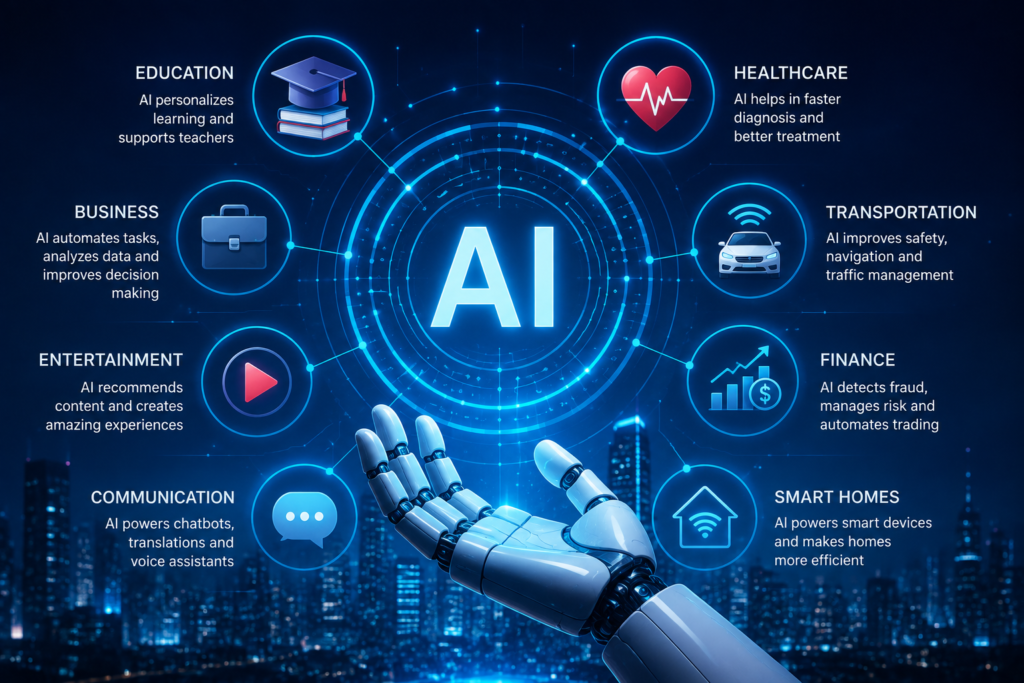
Artificial Intelligence is developing rapidly in 2026 and is becoming an important part of everyday life, business, education, healthcare, technology, and entertainment. The future of AI is moving beyond simple chatbots and content generation toward more intelligent systems that can perform tasks, make decisions, and work alongside humans.
According to recent 2026 reports, major trends include AI agents, robotics, multimodal AI, workplace automation, healthcare applications, and stronger AI safety and governance. (IEEE Computer Society)
1. AI Agents Will Become More Common
One of the biggest developments in 2026 is the growth of AI agents.
Unlike a normal chatbot that only answers questions, an AI agent can perform a series of tasks. For example, an AI agent may be able to:
- Research information
- Write emails
- Schedule meetings
- Analyze data
- Create reports
- Manage workflows
- Assist customers
AI agents are expected to reduce repetitive office work and help businesses become more productive. (IEEE Computer Society)
2. AI Will Change the Workplace
AI is changing the way people work rather than simply replacing every job.
In 2026, many professionals are using AI as an assistant for:
- Writing content
- Data analysis
- Programming
- Customer service
- Graphic design
- Marketing
- Research
- Business management
The most successful workers may be those who learn how to combine their human skills with AI technology.
3. AI and Education Will Become More Personalized
AI will continue to transform education by providing personalized learning experiences.
Students may receive:
- AI tutors
- Instant feedback
- Personalized study plans
- Interactive lessons
- Language assistance
- AI-generated practice questions
Teachers can also use AI to prepare lesson plans, worksheets, quizzes, and educational content more efficiently.
However, teachers will remain important because education also requires human guidance, motivation, creativity, and emotional support.
4. AI Will Improve Healthcare
Artificial Intelligence has the potential to make healthcare faster and more efficient.
AI can assist doctors and healthcare professionals with:
- Analyzing medical data
- Detecting patterns
- Supporting medical research
- Improving patient communication
- Developing personalized treatments
In the future, AI may become an important assistant for medical professionals rather than replacing doctors.
5. AI Will Move Into the Physical World
AI is no longer limited to computers and smartphones.
In 2026, AI is increasingly being connected with:
- Robots
- Smart factories
- Autonomous systems
- Vehicles
- Smart homes
- Industrial machines
This development is often called Physical AI or Embodied AI. AI-powered systems will increasingly interact with the real world, although robotics still faces challenges involving safety, reliability, cost, and adaptability. (Forrester Research, Inc)
6. Generative AI Will Become More Advanced
Generative AI will continue creating:
- Text
- Images
- Videos
- Music
- Computer code
- Designs
The next generation of AI tools will likely become more capable of understanding multiple types of information together, such as text, voice, images, and video.
This will make AI tools more useful for content creators, businesses, students, marketers, and designers.
7. AI Will Transform Businesses
Businesses are increasingly adopting AI to improve productivity and customer experience.
AI can help companies with:
- Customer support
- Marketing
- Sales analysis
- Content creation
- Automation
- Fraud detection
- Business forecasting
Recent data also shows AI adoption continuing to grow across organizations and industries. (Stanford HAI)
8. New Jobs Will Be Created
While AI may automate some tasks, it will also create new career opportunities.
Future AI-related jobs may include:
- AI Engineer
- Machine Learning Specialist
- AI Content Creator
- Prompt Specialist
- AI Trainer
- Data Analyst
- AI Security Specialist
- AI Ethics Professional
- Robotics Engineer
People who learn AI skills may have better opportunities in the future workplace.
9. AI Safety and Ethics Will Become More Important
As AI becomes more powerful, concerns about its responsible use will also increase.
Important issues include:
- Privacy
- Data security
- Misinformation
- Deepfakes
- Bias
- Copyright
- Cybersecurity
- Responsible AI use
Governments, companies, and international organizations are increasingly focusing on AI governance and trustworthy deployment. (World Economic Forum)
10. Humans and AI Will Work Together
The biggest future trend may not be AI versus humans.
Instead, the future will likely focus on:
Humans + AI Working Together
Humans provide:
- Creativity
- Emotions
- Critical thinking
- Leadership
- Judgment
- Empathy
AI provides:
- Speed
- Automation
- Data processing
- Pattern recognition
- 24/7 availability
By combining these strengths, humans and AI can potentially achieve more together.
Conclusion
The future of Artificial Intelligence in 2026 is exciting and transformative. AI is becoming more intelligent, accessible, and integrated into everyday life. From education and healthcare to business and robotics, AI is changing how people work and interact with technology.
However, AI also brings important challenges related to privacy, employment, safety, and ethics. The future will depend not only on how powerful AI becomes, but also on how responsibly humans choose to develop and use it.
Final Thought
The future of AI is not simply about machines becoming smarter—it is about humans learning how to use intelligent technology responsibly to create a better future.