September 5, 2026
Artificial Intelligence in Healthcare: Detailed Information
Introduction to AI in Healthcare
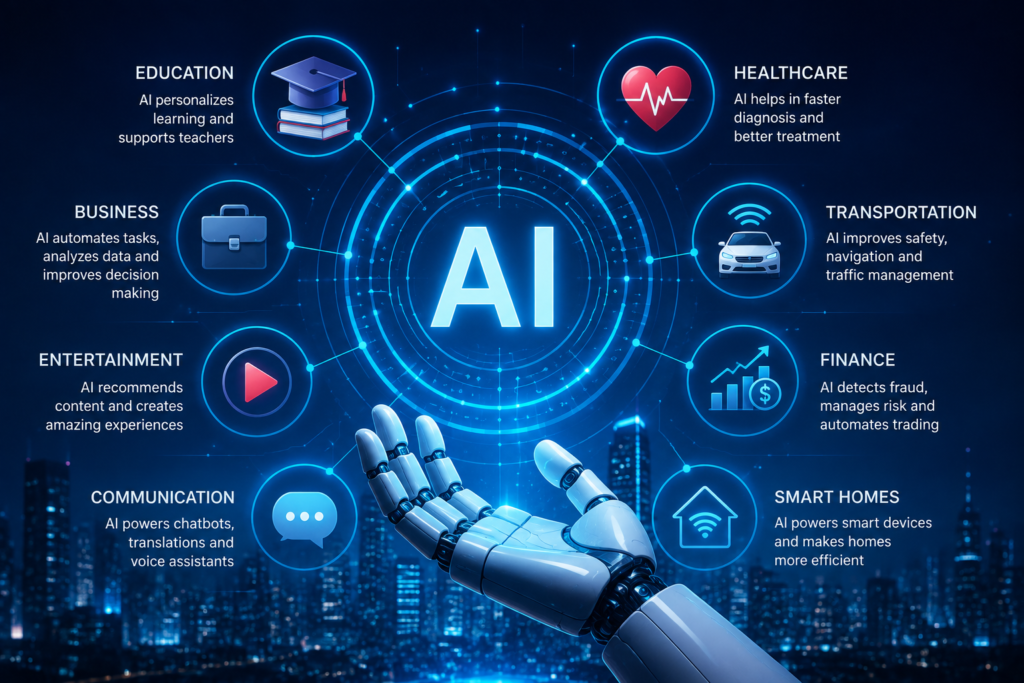
Artificial Intelligence (AI) is transforming the healthcare industry by helping doctors, hospitals, researchers, and patients make better decisions. AI uses technologies such as machine learning, deep learning, natural language processing, and computer vision to analyze large amounts of medical data and identify useful patterns.
AI does not simply replace doctors. Instead, it acts as a powerful assistant that can help healthcare professionals diagnose diseases, analyze medical images, predict health risks, and provide personalized treatment.
1. AI Helps in Disease Diagnosis
One of the most important uses of AI in healthcare is disease diagnosis.
AI systems can analyze patient information, including:
- Medical history
- Symptoms
- Blood test results
- X-rays
- MRI scans
- CT scans
- Genetic information
By analyzing this data, AI can identify patterns that may help doctors detect diseases earlier.
Examples:
AI can assist in detecting:
- Cancer
- Heart disease
- Diabetes
- Lung diseases
- Brain disorders
- Eye diseases
Early diagnosis can improve treatment outcomes and potentially save lives.
2. AI in Medical Imaging
Medical imaging is one of the fastest-growing applications of AI in healthcare.
AI-powered systems can analyze images such as:
- X-rays
- CT scans
- MRI scans
- Ultrasound images
For example, AI can help identify unusual areas in an X-ray or detect possible tumors in medical scans.
Benefits of AI in Medical Imaging:
- Faster image analysis
- Improved accuracy
- Early disease detection
- Reduced workload for radiologists
- Better support for doctors
However, doctors are still responsible for reviewing results and making final medical decisions.
3. AI in Personalized Medicine
Every patient is different. People may respond differently to the same medicine or treatment.
AI can analyze information about a patient’s:
- Age
- Medical history
- Lifestyle
- Genetic information
- Previous treatments
Using this information, doctors may be able to develop more personalized treatment plans.
Example:
Instead of giving every patient the same treatment, AI can help healthcare professionals identify which treatment may work best for a particular individual.
This approach is called personalized or precision medicine.
4. AI in Drug Discovery
Developing a new medicine usually takes many years and requires significant investment.
AI can help researchers speed up parts of the drug discovery process.
AI can:
- Analyze millions of chemical compounds
- Predict how molecules may behave
- Identify potential drug candidates
- Support clinical research
- Reduce the time needed for early-stage research
This technology can help scientists discover new treatments for diseases more efficiently.
5. AI-Powered Virtual Health Assistants
AI-powered chatbots and virtual assistants can provide basic healthcare support.
They can help users:
- Schedule appointments
- Receive medication reminders
- Track health information
- Answer general health questions
- Find basic medical information
Virtual assistants are especially useful for providing support outside normal hospital hours.
However, AI chatbots should not be considered a replacement for professional medical advice, especially in emergencies or serious health conditions.
6. AI in Robotic Surgery
AI technology is also being used alongside robotic systems in surgery.
Robotic surgical systems can help surgeons perform certain procedures with greater precision and control.
Potential benefits include:
- More precise movements
- Smaller incisions
- Reduced recovery time
- Less blood loss in some procedures
- Better visualization during surgery
Importantly, surgeons remain in control of the procedure. AI and robotic systems are tools that assist medical professionals.
7. AI for Predicting Health Risks
AI can analyze patient data to identify potential health risks before serious problems develop.
For example, AI may help identify patients who could have a higher risk of:
- Heart attacks
- Diabetes complications
- Stroke
- Hospital readmission
- Certain infections
This allows doctors and hospitals to monitor high-risk patients more carefully and take preventive action.
8. AI in Hospital Management
AI is not only used for treating patients. It can also improve hospital operations.
AI can help hospitals with:
- Appointment scheduling
- Managing patient records
- Predicting patient demand
- Managing hospital beds
- Reducing administrative work
- Improving staff efficiency
By automating repetitive tasks, healthcare workers can spend more time focusing on patients.
9. AI and Wearable Health Devices
Smartwatches and fitness trackers increasingly use AI to analyze health-related information.
These devices can monitor:
- Heart rate
- Physical activity
- Sleep patterns
- Oxygen levels
- Exercise habits
AI can analyze this information and provide insights about a person’s general health and lifestyle.
Wearable technology is helping people become more aware of their health and encouraging preventive care.
Benefits of AI in Healthcare
1. Faster Diagnosis
AI can quickly analyze large amounts of medical data and assist doctors in identifying possible diseases.
2. Improved Accuracy
AI systems can recognize complex patterns that may be difficult to identify manually.
3. Early Detection of Diseases
AI can help detect potential health problems at an earlier stage.
4. Personalized Treatment
AI can support treatment plans based on an individual’s unique medical information.
5. Reduced Healthcare Costs
Automation and efficient data analysis may reduce some administrative and operational costs.
6. Better Patient Experience
AI-powered systems can provide faster responses, reminders, and easier access to healthcare information.
7. Support for Medical Professionals
AI can reduce repetitive workloads and help doctors focus more on patient care.
Challenges and Risks of AI in Healthcare
Although AI offers many benefits, there are also important challenges.
1. Data Privacy
Medical information is highly sensitive. Healthcare organizations must protect patient data from misuse or unauthorized access.
2. Accuracy Problems
AI systems can make mistakes. Incorrect or incomplete data can lead to inaccurate results.
3. Bias in AI Systems
If AI is trained using biased or incomplete data, it may not perform equally well for all groups of patients.
4. Lack of Human Judgment
AI cannot fully replace the experience, empathy, and professional judgment of doctors and healthcare workers.
5. High Implementation Costs
Advanced AI technology, infrastructure, training, and maintenance can be expensive.
6. Ethical and Legal Issues
Questions about responsibility and accountability arise when AI systems are involved in medical decisions.
The Future of AI in Healthcare
The future of AI in healthcare is expected to be highly advanced and transformative.
In the coming years, AI may help create:
- More accurate disease prediction systems
- Advanced robotic surgeries
- Personalized medicines
- AI-powered hospitals
- Smart wearable health devices
- Faster drug discovery
- Virtual healthcare assistants
- Better remote patient monitoring
The combination of AI and human healthcare professionals could create a more efficient and accessible healthcare system.
Conclusion
Artificial Intelligence is becoming an important part of modern healthcare. It is helping doctors diagnose diseases, analyze medical images, discover new medicines, personalize treatments, and improve hospital management.
However, AI should be used responsibly. Human doctors and healthcare professionals will continue to play a critical role because medical care requires human judgment, experience, communication, and empathy.
The future of healthcare is not about AI replacing doctors—it is about AI and healthcare professionals working together to provide better care for patients.
Short Blog Title Ideas:
- How AI Is Transforming Healthcare
- The Future of Artificial Intelligence in Healthcare
- AI in Healthcare: Benefits, Challenges, and Future
- How Artificial Intelligence Is Saving Lives.
- vv